From: Simon & Nick – National Emergency Briefing via ActionNetwork.org<info@nebriefing.org>
Date: Fri, 5 Jun 2026 at 14:37
Subject: Responding to MPs / Approaching Mark Kermode
|
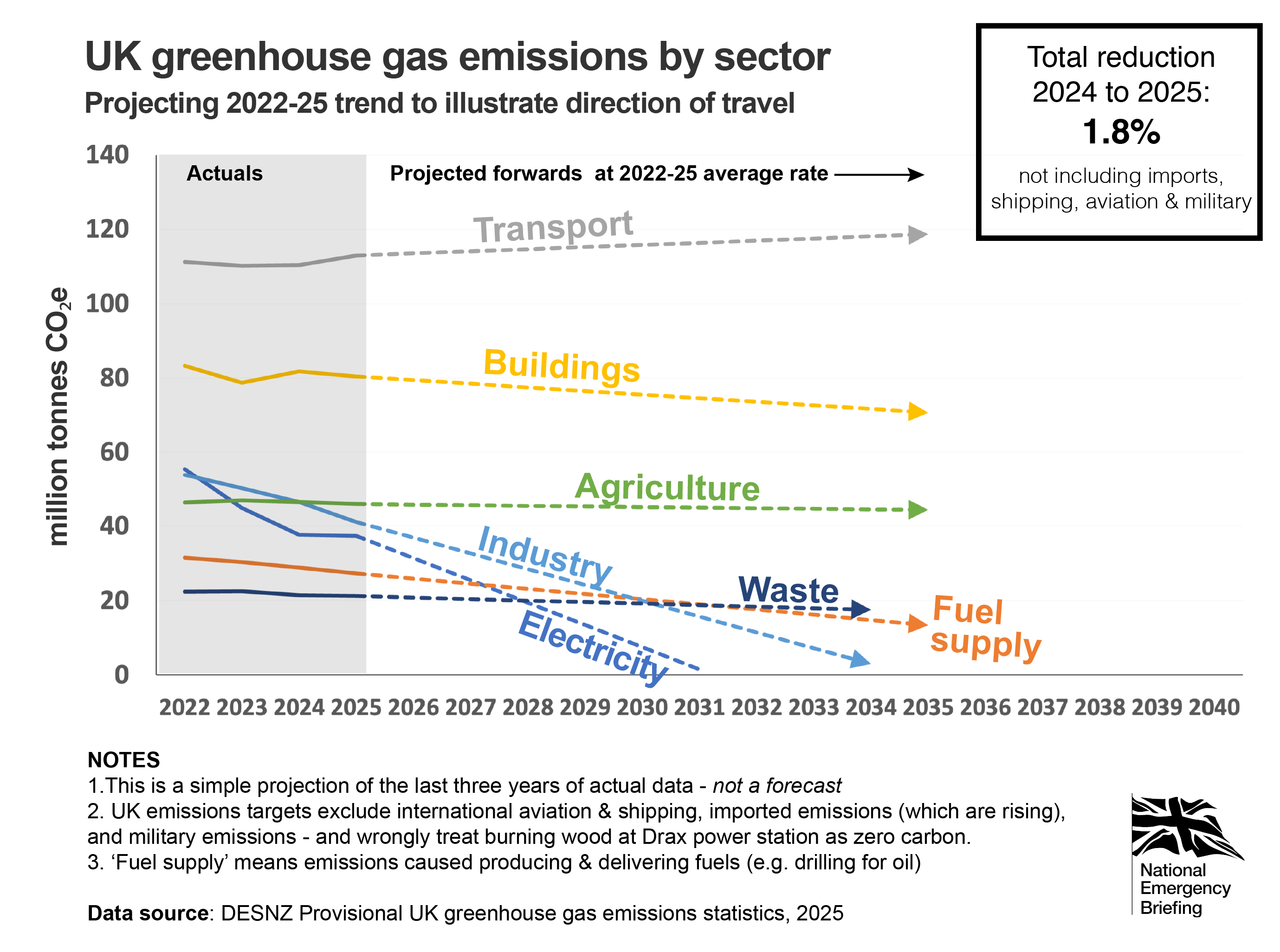
Dear XXX, Film review Kermode & Mayo’s Take is one of the UK’s best-loved film review programmes, and we’d love them to see this unusual new documentary, now showing in communities and workplaces across the country. If you’re a listener, fan, or think they may find it interesting, a kind nudge from supporters could make all the difference. Their email is: correspondence@kermodeandmayo.com. Responding to MPs Dear XXX Thank you for that impressive list of policies and promises. I would expect a government facing a challenge as serious as the climate and nature crisis to have a long list. But the key question is.. Is it enough? Is it commensurate with the level of threat? I very much welcome the great work in decarbonising the power sector. But that is only around a fifth of our energy usage. You can see that clearly on this graphic which looks at UK actual emissions by sector for the last three years with recent trends extrapolated forward. This is a simple technique to help illustrate recent progress – these are not forecasts. Electricity – a phenomenal success! But decarbonising power can largely happen behind the scenes. Reducing emissions from transport, housing, food and land use is different. It requires broad public understanding and support because it affects people’s everyday lives. History shows that when societies understand a genuine national challenge, they are capable of remarkable collective action. The experts featured in the National Emergency Briefing set out why the threats presented by the climate and nature crisis now warrant a wartime-scale response. That raises an important democratic question. If the risks are as serious as leading experts say, shouldn’t the public be fully informed about them? How else can citizens make well-informed decisions about the future direction of the country? Isn’t transparency with the electorate a core democratic principle? For that reason, I would be very grateful if you would join colleagues in supporting the Parliamentary Call for a televised emergency briefing, introduced by the Prime Minister and delivered by independent experts. You can see which MPs and peers have already added their name here: https://www.nebriefing.org/parliamentary-call – and the core principles for a successful government-led briefing are here: https://www.nebriefing.org/briefing-principles. Kind regards The graphic above can be found here: https://www.nebriefing.org/mp-dialogue/uk-progress. Other news The government petition for a UK-wide briefing now has over 20,000 signatures. Can you help us get it to 100,000 to secure a Parliamentary debate? https://petition.parliament.uk/petitions/767687 There are now 1,417 pins on our screening map. Screenings are spreading to other countries. By request, we are working on translating subtitles into: German, Danish, French, Bengali, Spanish (Latin American), Portuguese (Brazilian), Turkish. Welsh subtitles are already available. Please share with friends overseas who may be interested. We are working with education experts on a youth engagement plan, guiding young people in interactions with their MP. Climate Minister Katie White has agreed to meet with us, with Prof Mike Berners-Lee – dates being arranged. Andrew George MP is gathering support in Parliament for Early Day Motion calling for a UK-wide briefing which now has 81 MP signatories. This is running in parallel with our Parliamentary Call – a great way to raise awareness with MPs. Approaches have been made on our behalf to the UN, UNESCO and the European Parliament asking them to screen the film internally, showcasing this new approach to climate / nature comms. For upcoming zooms, recordings, and other info, please check the NEB Noticeboard: https://tinyurl.com/NEBNoticeboard. Thank you again for your support very best wishes on behalf of the National Emergency Briefing team
|
 The survey data being collected by Bath University at screenings of the People’s Emergency Briefing strongly indicates that many people have little understanding of either the scale and immediacy of the risks facing the UK, or the practical solutions available. But people cannot be expected to support (and make) significant changes if nobody has explained why they are needed.